
Free rock and mineral tools
What did you just find?
Name rocks, minerals and crystals with a guided identifier, scratch-test them on a real Mohs scale, and get honest odds on that possible meteorite. Free, in your browser, no sign-up.
Free toolsNo sign-upNo photo uploads
 Field find
Specimen 042AmethystHardness 7
Tap the card to read its field notes.
rocks, minerals and look-alikes in the free guided identifier, each with its sources.
5.5Window glass on the Mohs scale. If your rock scratches glass, it is harder than that.
95%of meteorites attract a cheap magnet, per Washington University in St. Louis. Most magnetic rocks are still Earth rocks.
Free tools
Three free tools that do real field tests
Hardness, streak and a few simple tricks name most common rocks and minerals. These tools walk you through them, then tell you honestly what they can and cannot say.
 Start here
Rock identifier
Answer up to six quick questions (color, luster, a scratch test, streak, texture, magnet and vinegar) and see the likely candidates from 66 rocks and minerals, why each fits and what to test next.
Identify my rock Scratch test
Mohs hardness scale
The ten reference minerals, everyday testers from fingernail to glass, a scratch simulator, and more than 90 minerals, gems, metals and rocks with their hardness.
Open the scale Honest odds
Is it a meteorite?
Nine checks from fusion crust to streak, an honest verdict, the meteor-wrongs your answers point to, and who can confirm a real one.
Check my rockScratch lab
Can you name the mystery mineral?
Five specimens, four testers. Scratch each one with a fingernail, a copper coin and a steel knife, try it on glass, then name it. It is the same test geologists use in the field.
How the app will work
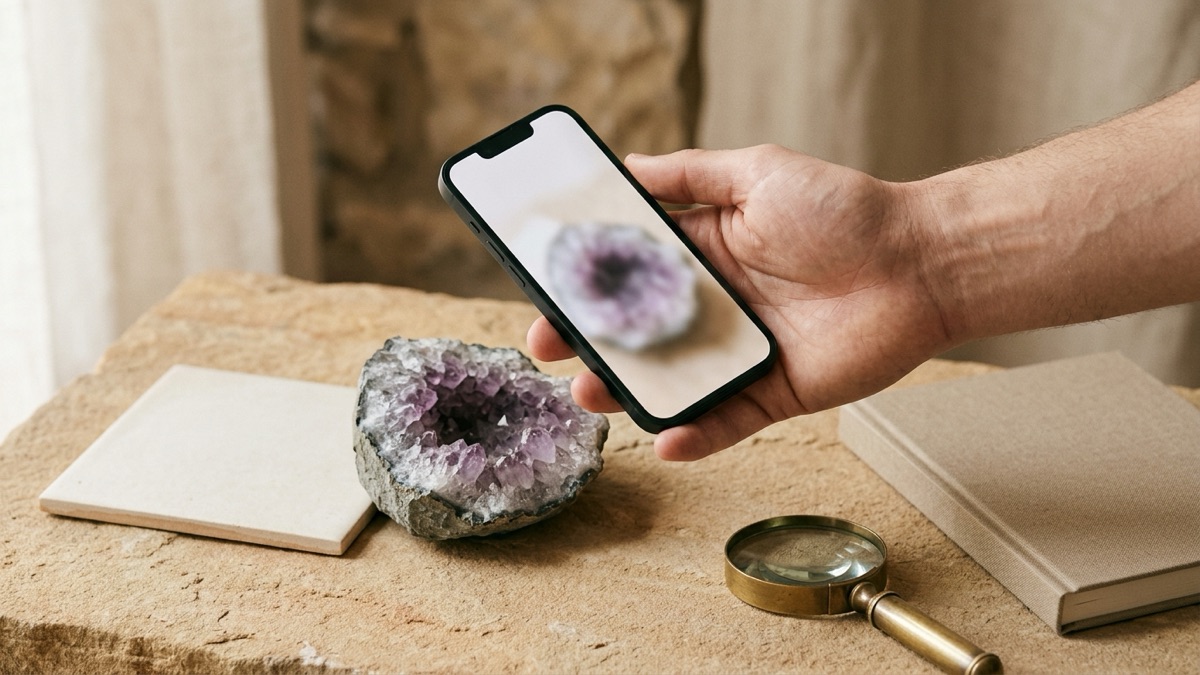
Snap it, narrow it down, confirm it
- 1
Snap your find
Photograph it in daylight, dry and wet, with a coin for scale. The app will guide the shot.
- 2
See likely candidates
Ranked matches with the properties that fit and the ones that do not, never one overconfident answer.
- 3
Confirm with a quick test
The app tells you which test separates your top matches: a scratch, a streak, a magnet or a drop of vinegar.
- 4
Keep a field journal
Save each find with where and when you found it, plus the collecting rules for that kind of land.
What makes a rock identifiable
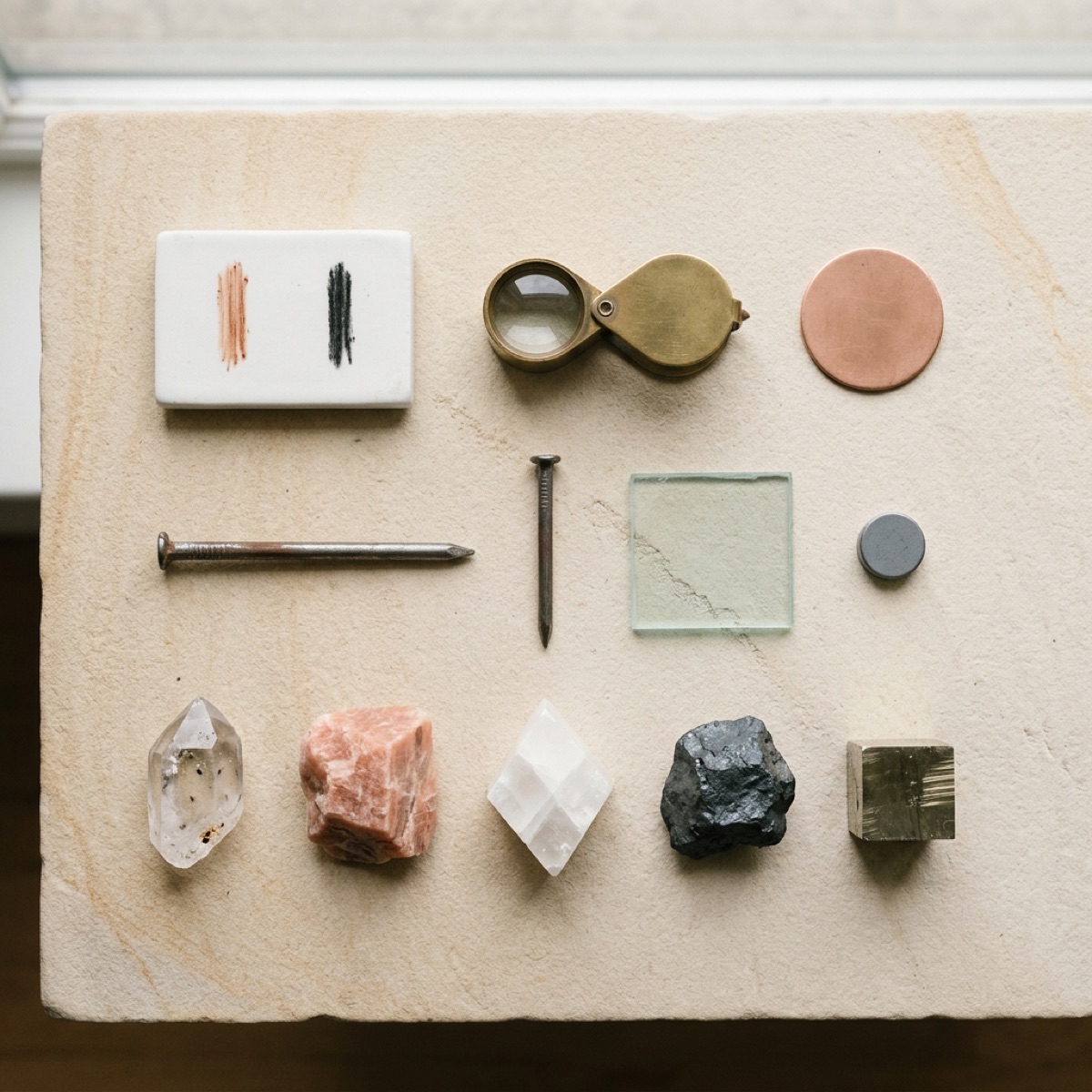
Six clues name most rocks. Color comes last.
Rockhounds and geologists check the same things, roughly in this order of trust. Every one of them works with things you already own.
Hardness most reliable
Scratch it with a fingernail, a copper coin and a steel knife, then try it on glass. Hardness barely changes from one sample to the next.
Streak very reliable
The color of its powder on a white tile. Hematite can look silver but always streaks red-brown.
Luster
How the surface throws back light: metallic, glassy, dull, waxy, pearly or silky.
Crystal shape and cleavage
Six-sided quartz points, pyrite cubes, calcite breaking into slanted boxes, mica peeling in sheets.
Weight and magnetism
Galena and barite feel heavy, pumice can float, and magnetite grabs a fridge magnet.
Color least reliable
Useful, but quartz alone comes in almost every color. Wet the rock and use color last.
From the field guides
Fresh guides for rockhounds

The honest bit
RockhoundID suggests likely candidates, not a certain identification. Many minerals share a color, rocks are mixtures, and weathered skins hide what is inside, so any quiz or photo answer can be wrong. For anything that might be valuable, rare or from space, have it looked at by a rock club, a museum, a university geology department or your state geological survey. We never invent ratings or user counts, every property in the tools lists its source, and any price on the site says when it was checked.
Questions
Good questions, straight answers
Is RockhoundID free?
The rock identifier, the Mohs hardness scale and the meteorite checker are free, with no account. The RockhoundID app is in development; early-access members hear about it first.
Can RockhoundID tell me exactly what my rock is?
No tool can promise that from a few answers or a photo. RockhoundID ranks likely candidates, shows why each fits and tells you which simple test to do next. For anything valuable or unusual, ask a rock club, a museum or your state geological survey.
How can I tell if my rock is a meteorite?
Start with the fusion crust: a thin, dark rind that is darker than the inside. Then try a cheap fridge magnet and look for metal specks on a broken face. The meteorite checker walks you through every check and gives an honest verdict.
Do the tools upload my photos?
No. The tools on this site ask questions instead of taking photos, and everything runs in your browser.
Can I collect rocks anywhere?
No. Collecting is not allowed in national parks. Casual collecting of reasonable amounts for personal use is allowed on most Bureau of Land Management land, with limits and closed areas, and private land needs the owner's permission. Always check the rules for the exact place.
What is the Mohs hardness scale?
A 1 to 10 ranking of how easily minerals scratch, from talc (1) to diamond (10). A fingernail is about 2.5 and window glass about 5.5. Try the Mohs hardness scale.
Is RockhoundID affiliated with the USGS, a museum or another app?
No. RockhoundID is an independent project by Viral Labs and is not affiliated with any agency, museum, lab, dealer or other identification app.